
Best AI Pitch Deck Generators in 2026: We Gave 6 Tools the Same Brief

Most "best AI pitch deck generator" lists are written by people who never opened the tools. So in August 2026 we did it the slow way: fresh accounts, the same investor-deck brief for every tool, every run timed, every artifact saved — and special attention paid to the one thing that decides whether an AI deck helps you or embarrasses you: what each tool does when it hits a fact it can't know.
The short version: the AI pitch deck category has split into two generations. Research agents (Manus, Genspark, PageOn, and now Gamma's Agent mode) actually search the web during generation, pull real market figures, and cite sources on the slide. Template-fillers pour your company name into a fixed skeleton and leave $XX/mo placeholders where your business model should be. That generation gap matters more than any individual feature — and no listicle we found tells you which side of it each tool is on.
How we tested
The brief. Every tool received this prompt, verbatim:
Create a 10-slide investor pitch deck for "Nimbus Coffee", a specialty coffee subscription startup. Brand color #2F6B4F. Slides: cover, problem, solution, product, market size (include a chart with real market data and sources), business model, competition, traction, team, ask. English, professional tone.
Nimbus Coffee is a fictional company invented for this test; any resemblance to real businesses is coincidental. The brief is deliberately realistic — and deliberately incomplete. It names no founders, no revenue, no traction. A founder's real brief is always incomplete too, so what a tool does with those gaps is a scored dimension here, not an accident. Where a tool had no free-form prompt box (Slidebean only accepts a company name plus a short description), we mapped the brief into its input fields and note that in the tool's section.
What we measured: time to a finished deck, instruction adherence (we asked for exactly 10 slides — a surprisingly effective test), whether the market slide contains real, sourced data (checkable against the research firms' own published reports), design quality, honesty about missing information, and what each free tier actually lets you walk away with.
Scope notes. Beautiful.ai was tested up to — but not past — its credit-card wall (details below). Presentations.ai could not complete signup on our test rig, so it is excluded rather than reviewed second-hand. Canva, Microsoft Copilot, and Google Gemini live inside broader suites and get their own follow-up article. Tome, once a major name here, shut down in 2025 — every tool below can replace it.
The verdict table
| Tool | Time to deck | Slides (asked: 10) | Real market data + sources on slide | Facts it couldn't know | Free tier gives you |
|---|---|---|---|---|---|
| PageOn | ~7 min (3 one-click confirmations) | 10 | ✅ SkyQuest, Grand View, Zion cited on slide | Invented team & traction, unlabeled | Full deck, online share link (file export is Pro) |
| Manus | ~7 min | 10 | ✅ Numbered citations: NCA, SCA, CMI, Fact.MR | Labeled placeholders ("role-based placeholders") | Full deck + PDF & PPTX download |
| Genspark | ~8 min | 10 | ✅ Grand View & CMI; chart built from data, sources printed on it | [Placeholder] + footnote; refused to fabricate bios | First agent deck free (HTML + PDF)* |
| Gamma (Agent) | ~7 min | 11 | ✅ Grand View & Verified Market Reports, with a sources page | Invented a full story — named bios, subscriber counts, press — unlabeled | Deck + branded PDF; ~2 agent decks ≈ whole free budget |
| Slidebean | ~2 min | 13 | ❌ No research; template text & lorem ipsum | Leaves $XX/mo blanks (honest by vacancy) | Deck in editor only — all exports locked |
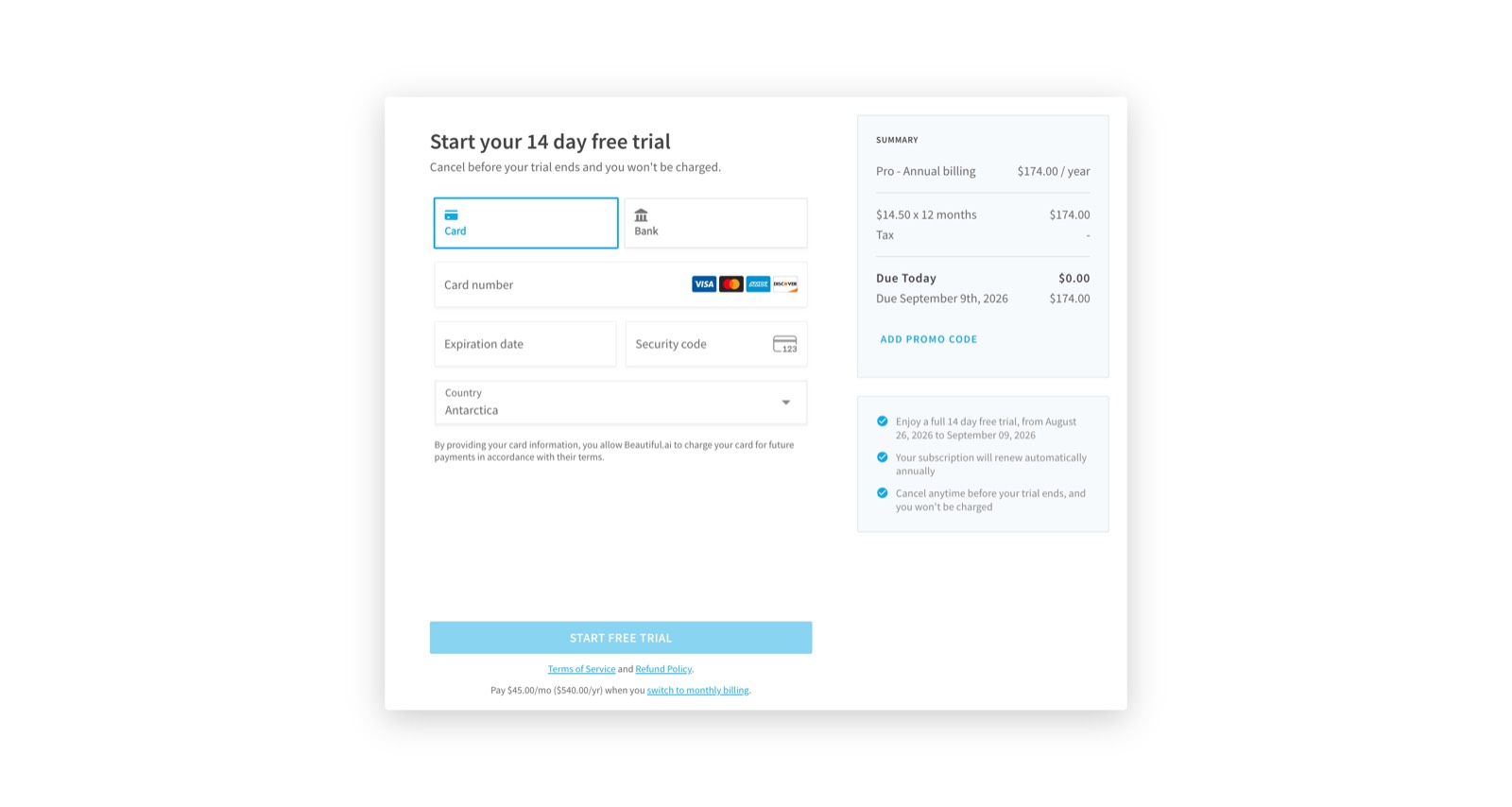
| Beautiful.ai | — | — | — | — | No free tier: trial requires a credit card ($174/yr auto-renews) |
Times are machine time from brief to finished deck; waiting on human input at confirmation gates is excluded. Every research tool's time includes its live web search. * Genspark's free first deck came with a caveat — see its section: on a fresh account created in late August 2026, we received zero free agent credits.
PageOn — the deck that looks ready to present
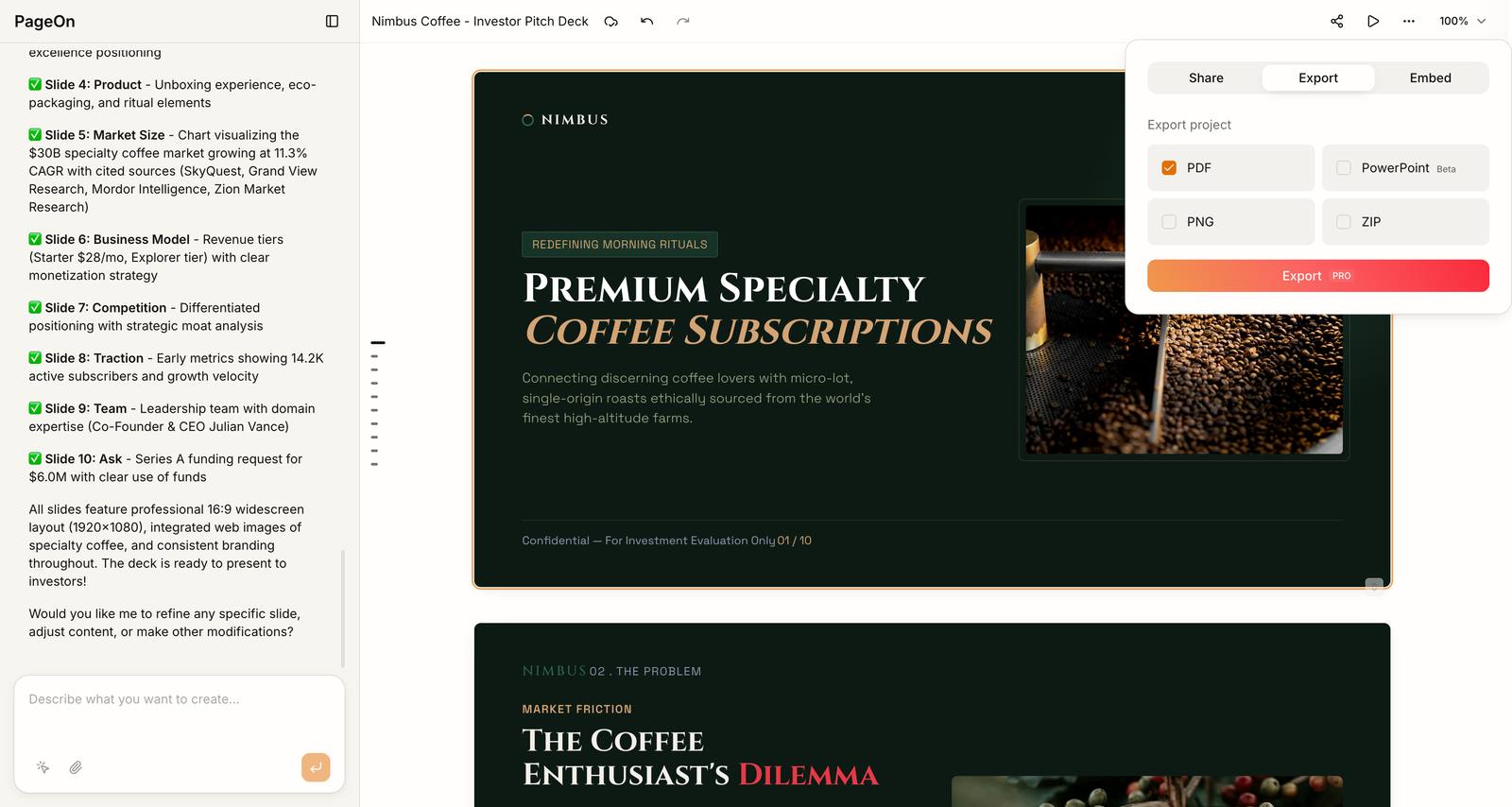
The run: 10 slides in about 7 minutes of machine time — roughly 2 of those minutes were the live web research the brief demands for the market slide, the rest image search and rendering. PageOn is the only tool in this test that confirms your intent before rendering: it paused three times — theme, image style, and a full outline for approval. Every gate has a one-click fast path ("Let AI decide", "Auto Select", "Confirm"), so hands-off users lose only seconds; hands-on users get real control over what gets built.
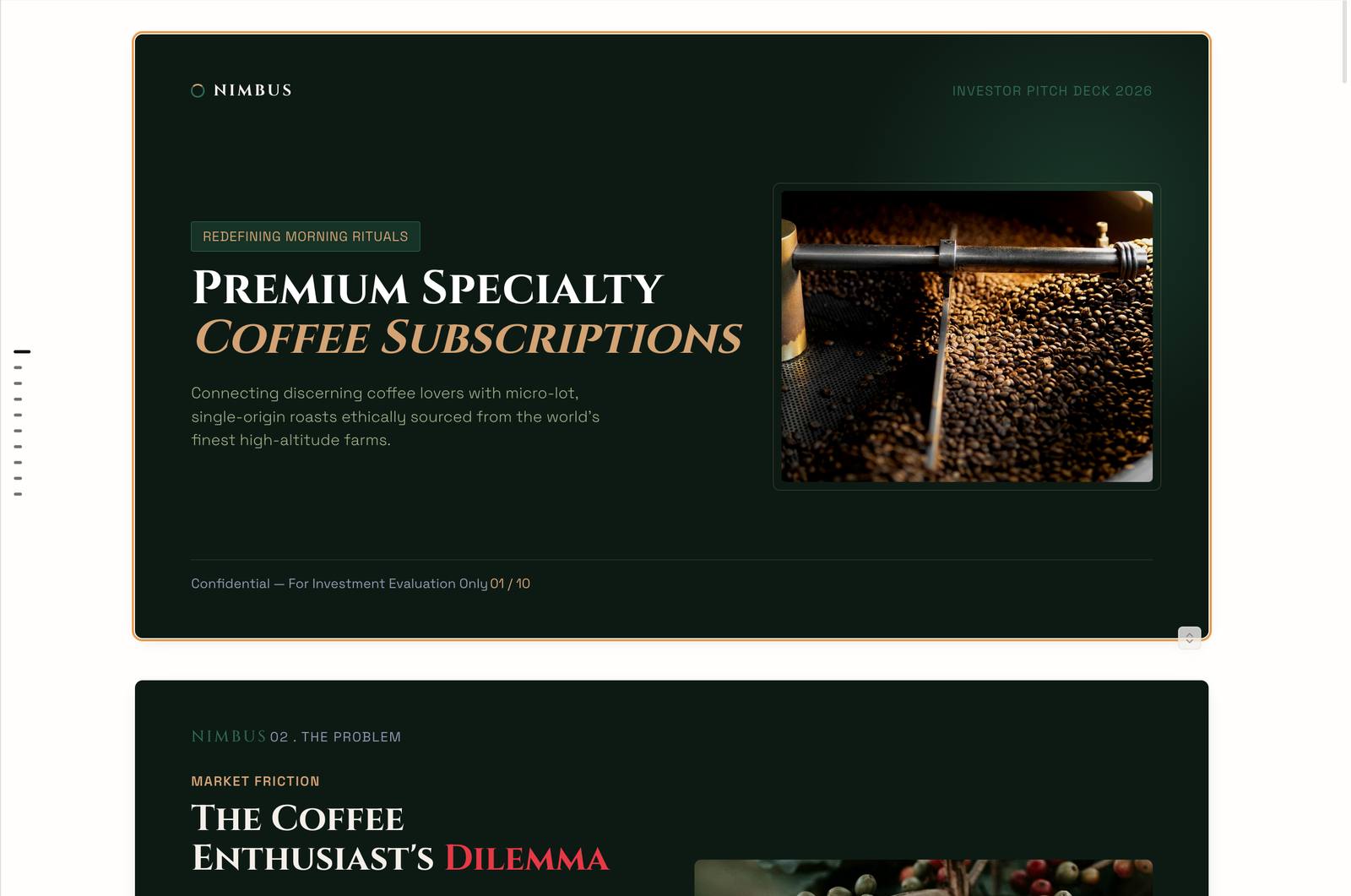
What impressed us: the best-looking deck of the six by a clear margin — a consistent deep-green theme built around the brand color we specified, real photography on every content slide, and not a single overflowing text box (two competitors had at least one). The market slide charted the $30.19B specialty-coffee market at 11.3% CAGR with SkyQuest, Grand View Research and Zion Market Research named right on the slide — figures you can check against those firms' own published reports.
What we'd flag: PageOn filled the team and traction slides with realistic-sounding invented names and metrics, with no "illustrative" label — see the honesty section below, and treat those slides as scaffolding to replace, on any tool. File export (PDF/PPTX/PNG) sits behind the Pro plan; the free tier shares a live link instead.
Manus — the fact-discipline champion
The run: zero-touch. Paste the brief, come back in about 7 minutes.
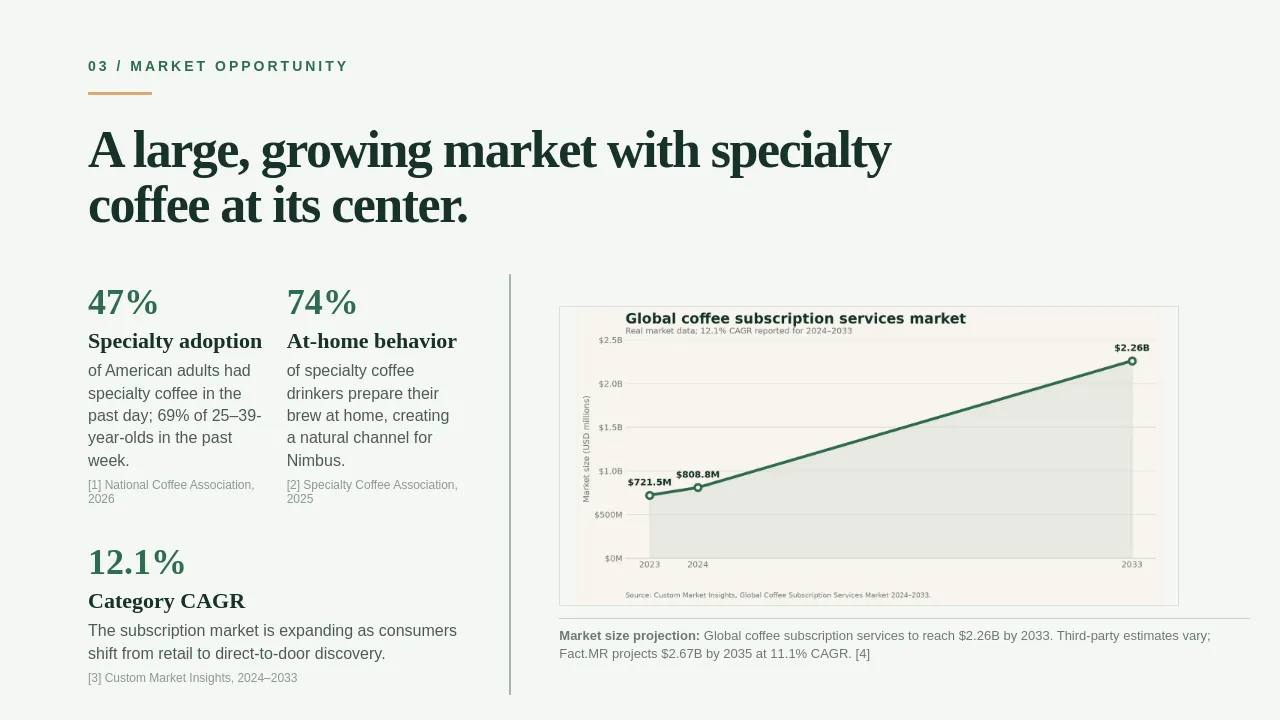
What impressed us: Manus was the only tool that treated missing facts as something to label rather than invent. Its team slide says, in print, "role-based placeholders"; its traction slide says "illustrative seed-stage targets." Its market slide carries numbered citations — National Coffee Association, SCA, Custom Market Insights, Fact.MR — and it even flagged that third-party market estimates disagree with each other. Its free tier is also the only one here that hands you both PDF and PPTX files.
We've also compared Manus and PageOn on a broader presentation workload — see Manus AI for presentations: tested.
What we'd flag: slide section numbering glitched (two slides labeled "03"), and the deck used no photography at all — clean editorial layout, but flatter than PageOn's or Gamma's output. Design is the trade-off for discipline.
Genspark — the self-checking engineer
The run: ~8 minutes, zero-touch, and the most transparent process of the six: you watch it run parallel web searches, read Grand View Research and Fact.MR reports, install matplotlib, and build the market chart from data — with the sources printed inside the chart image.
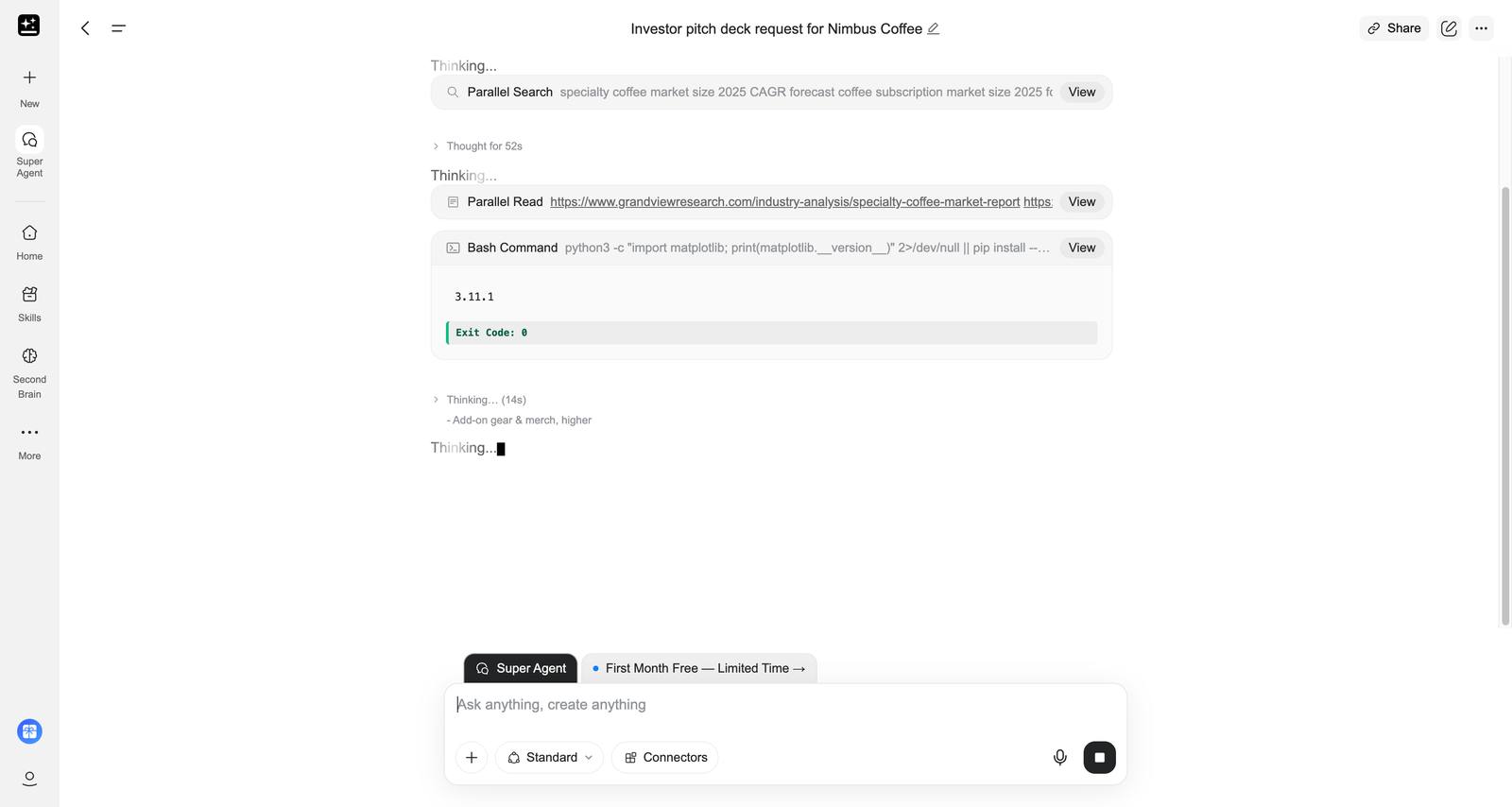
What impressed us: discipline you can read in its own process log — its internal instructions said, verbatim, "do not fabricate company traction or named team biographies," and the deck followed through: unknown numbers became labeled [Placeholder] entries with footnotes instead of confident fiction.
What we'd flag: one badly overflowing slide in the deck, and — more importantly — the free ride may be over. Our first agent deck was free (delivered as downloadable HTML + PDF). But when we re-checked in late August 2026 with a brand-new free account, it received zero agent credits — the run was refused before it started, and exports in the AI Slides app (PDF/PPTX/Google Slides) are paid-plan features. Budget for a subscription if you want Genspark decks today.
Gamma — fast, polished, and the most confident storyteller
The run: about 7 minutes in Gamma's new "Create with Agent" mode, which searches the web and cites sources — it has clearly joined the research-agent generation. Output: 11 slides. We asked for 10. It said "here's your complete 10-slide deck" while delivering 11.
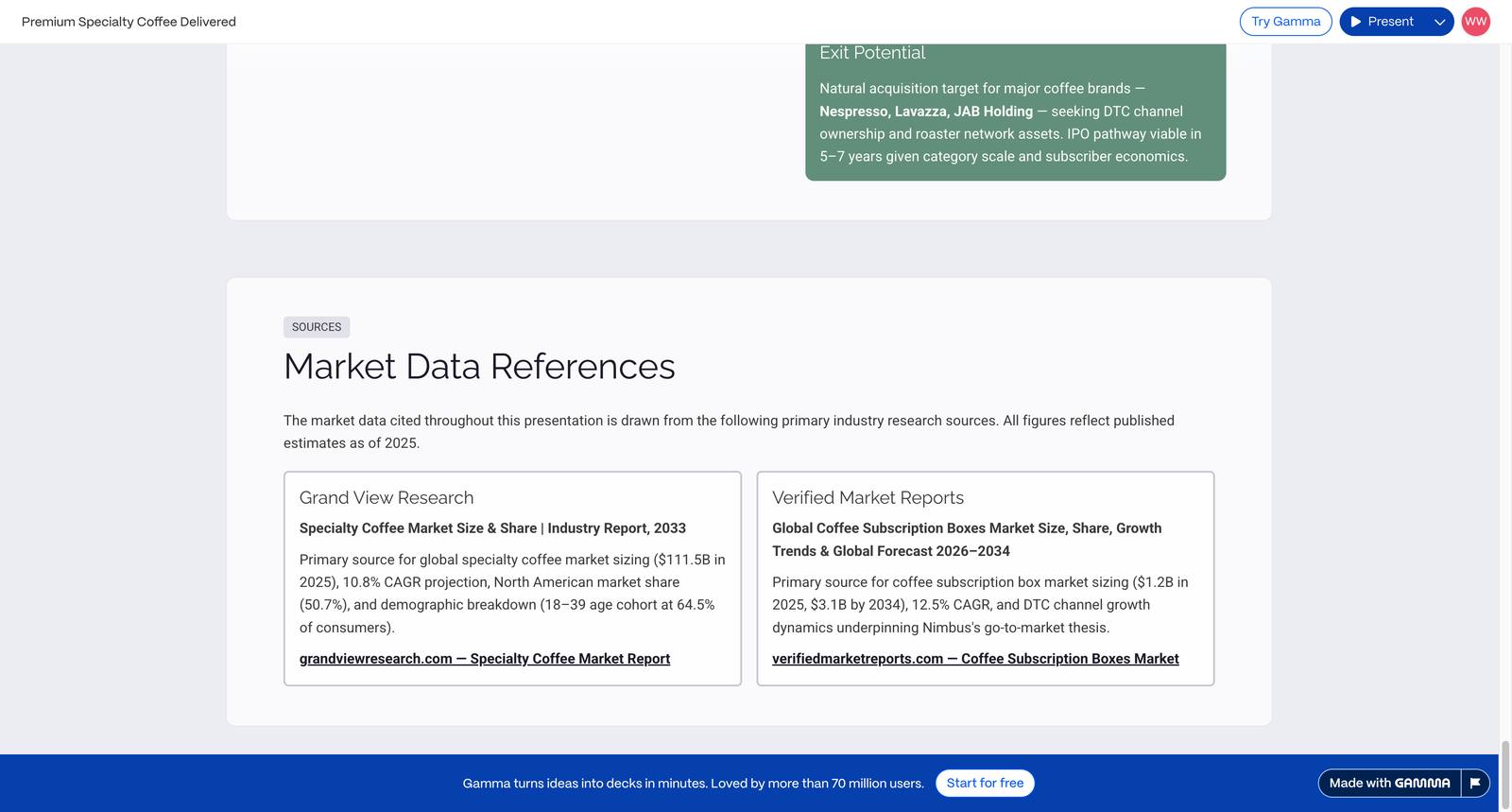
What impressed us: a pleasant default theme, real sourced figures on the market slide ($111.5B specialty-coffee market at 10.8% CAGR), and the best sourcing presentation of the six: a dedicated "Market Data References" page with the actual report names and working links to Grand View Research and Verified Market Reports. Free PDF export works (with "Made with Gamma" branding on every page).
Deciding between Gamma and PageOn specifically? See our dedicated Gamma vs PageOn head-to-head.
What we'd flag: Gamma was the most confident inventor in the test. It wrote an entire fictional company history as fact: named founders with detailed résumés tied to real companies, "450 beta subscribers, 89% retention, $18K MRR," twelve signed roaster partnerships, podcast appearances, even acquisition-exit speculation naming real corporations — none of it labeled as illustrative. It reads wonderfully and is precisely the kind of content an investor will ask you to substantiate. Also, budget: two agent decks consumed nearly the entire free credit allowance (400 → 69 credits).
Slidebean — a template with an autofill button
The run: fastest in the test (~2 minutes) — because it isn't doing research. Slidebean's AI accepts exactly two inputs, company name and a 600-character description; there is no way to pass instructions, which is why our request for 10 slides produced 13.
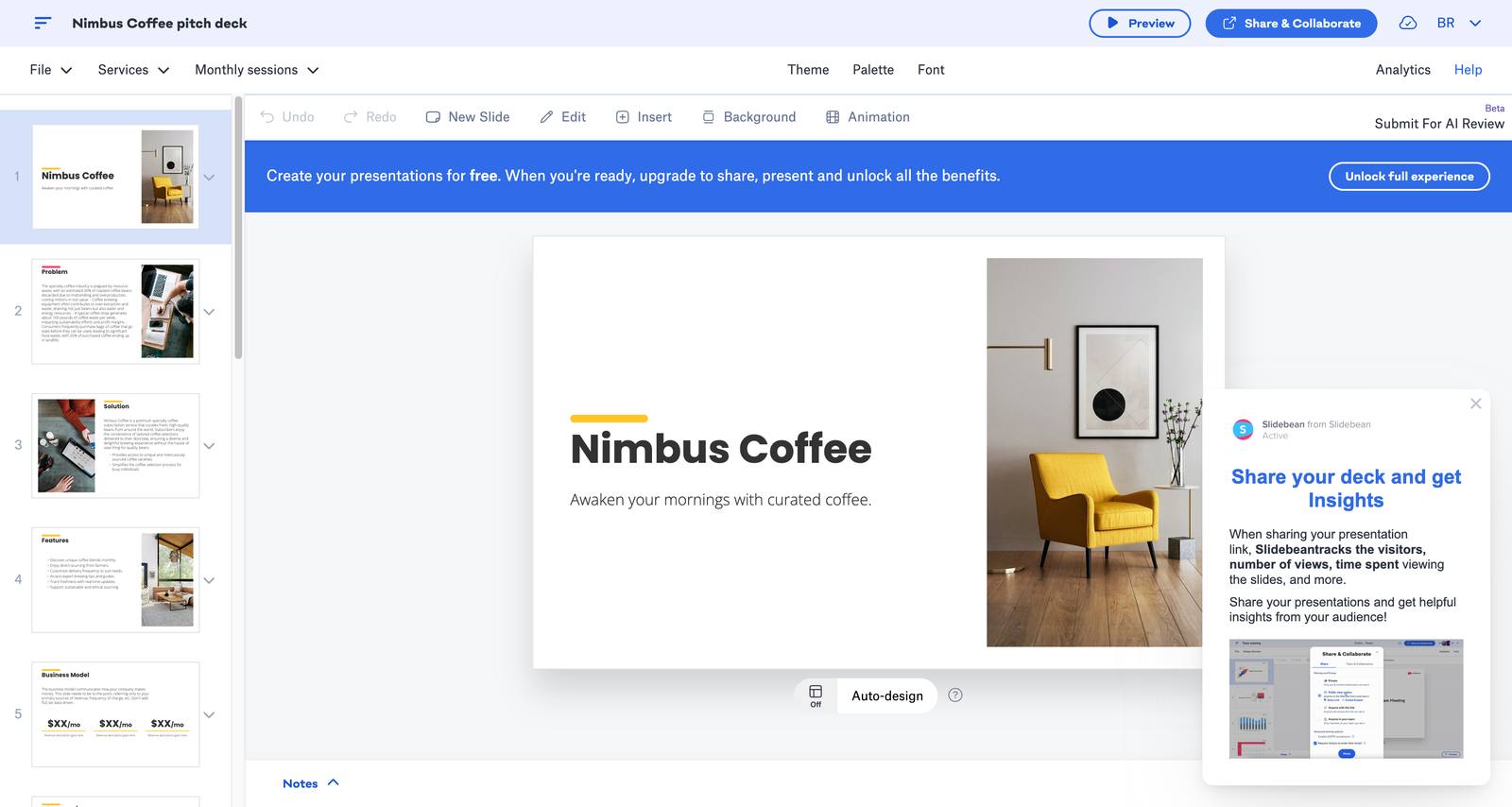
What we'd flag: of those 13 slides, the business-model slide read "$XX/mo — Revenue description goes here" three times, the roadmap slide was twelve lines of lorem ipsum, the fundraising slide said "Raising $XXX,XXX," and the financials table was empty. Export (HTML, PDF, PowerPoint) is entirely paywalled on the free plan. Slidebean's templates and human fundraising services may earn their keep elsewhere; as an AI generator in 2026, it's a previous-generation product.
Beautiful.ai — the card wall
We created an account, verified the email, completed onboarding — and hit a plan-selection screen with no free option. The 14-day trial requires a credit card before you can open the editor, and auto-renews at $174/year. We don't enter payment details for reviews, so output quality is honestly not tested — but if you searched "free AI pitch deck generator," this is the answer you needed: Beautiful.ai has no free tier, only a card-gated trial.
The honesty test: what each tool did with facts it couldn't know
Our brief named no founders, no revenue, no traction — just like most real briefs. Every tool had to fill a team slide and a traction slide anyway. This is where the field split:
| Tool | Team & traction slides contained | Labeled as illustrative? |
|---|---|---|
| Manus | Role descriptions and target ranges | Yes — in print, on the slide |
| Genspark | [Placeholder] entries with footnotes; internal rule "do not fabricate company traction or named team biographies" | Yes |
| Slidebean | Empty template fields ($XX, lorem ipsum) | N/A — nothing invented, nothing filled |
| PageOn | Realistic invented founder names and growth metrics | No |
| Gamma | A complete invented narrative: named bios tied to real companies, "450 beta subscribers, 89% retention, $18K MRR," signed partnerships, press coverage | No |
The pattern to internalize: the better the deck reads, the more dangerous the invention. A $XX/mo placeholder can't fool anyone; a confident slide claiming 89% retention can — including, eventually, you. Whichever tool you use, treat every company-specific number and name in a generated deck as scaffolding to replace, and keep the parts that are genuinely sourced: the market figures with citations printed on the slide.
What "free" actually buys you
| Tool | Deck generated | File you can keep |
|---|---|---|
| Manus | ✅ | PDF + PPTX |
| Gamma | ✅ (~2 agent decks per free budget) | PDF, Gamma-branded |
| Genspark | ✅ our first run; a fresh account in late Aug 2026 got zero free agent credits | HTML + PDF from that first run; app exports paid |
| PageOn | ✅ | Online share link; files are Pro |
| Slidebean | ✅ (template-fill) | None |
| Beautiful.ai | ❌ card required | — |
Which one should you use?
- You want the deck to look investor-ready with the least rework: PageOn — best visual output of the test, real sourced market data, and the intent confirmations mean the deck you get is closer to the deck you meant. Replace the team/traction scaffolding, and budget for Pro if you need the PPTX.
- You want a file on your disk without paying anyone: Manus — free PDF + PPTX, and the most honest handling of facts it can't know.
- You want to watch the research happen (or audit it): Genspark — the most transparent pipeline and the strictest no-fabrication discipline; but verify you actually get free credits before counting on it.
- You want a fast, polished draft and you'll fact-check it yourself: Gamma — great presentation of sources, but treat every company-specific claim as unverified fiction until you've replaced it.
- You want templates and human fundraising help rather than AI generation: that's the honest case for Slidebean.
FAQ
What is the best AI pitch deck generator in 2026?
For finished-deck quality with real, cited market data, PageOn produced the strongest result in our same-brief test; Manus is the best fully-free option (PDF + PPTX export at no cost); Genspark has the most rigorous research discipline. "Best" depends on whether you optimize for polish, price, or honesty — the verdict table above maps each.
Can AI pitch deck generators use real market data?
Yes — the current agent generation (PageOn, Manus, Genspark, Gamma Agent) searches the web during generation and cites named research firms on the slide. In our test, all four independently retrieved consistent specialty-coffee market figures from sources such as Grand View Research. Template-based tools do no research at all.
Will an AI-generated pitch deck contain made-up numbers?
For facts about your company — yes, unless you supply them. In our test, PageOn and Gamma filled team and traction slides with realistic invented names and metrics presented as fact; only Manus and Genspark used labeled placeholders. Always replace or verify every company-specific claim before presenting.
Which AI pitch deck generator is free?
Manus offers the most usable free tier (full deck + PDF/PPTX download). Gamma's free credits cover roughly two agent decks with branded PDF export. PageOn and Slidebean generate free but gate file export; Genspark's free agent credits appear to be gone for new accounts as of late August 2026; Beautiful.ai requires a credit card to try at all.
How long does an AI tool take to generate a pitch deck?
In our timed runs: about 2 minutes for template-fill (low quality) to 8 minutes for full research agents, plus a few seconds to a few minutes of your own input if the tool confirms theme and outline choices.
Can these tools export to PowerPoint (PPTX)?
On free tiers, only Manus delivered a PPTX in our test. Gamma, Genspark (AI Slides), PageOn and Slidebean all offer PPTX export on paid plans only.